A Google Workspace alternative for custom domain email without extra seats is a roster rule: seats are people, aliases are printed addresses. Keep Gmail or Outlook as the store for humans who already have an inbox. Route hello@, billing@, and jobs@ as aliases. Buy Workspace only when someone needs a hosted mailbox you administer. Publish one MX set and prove inbound before you pay for seats you will never log into.
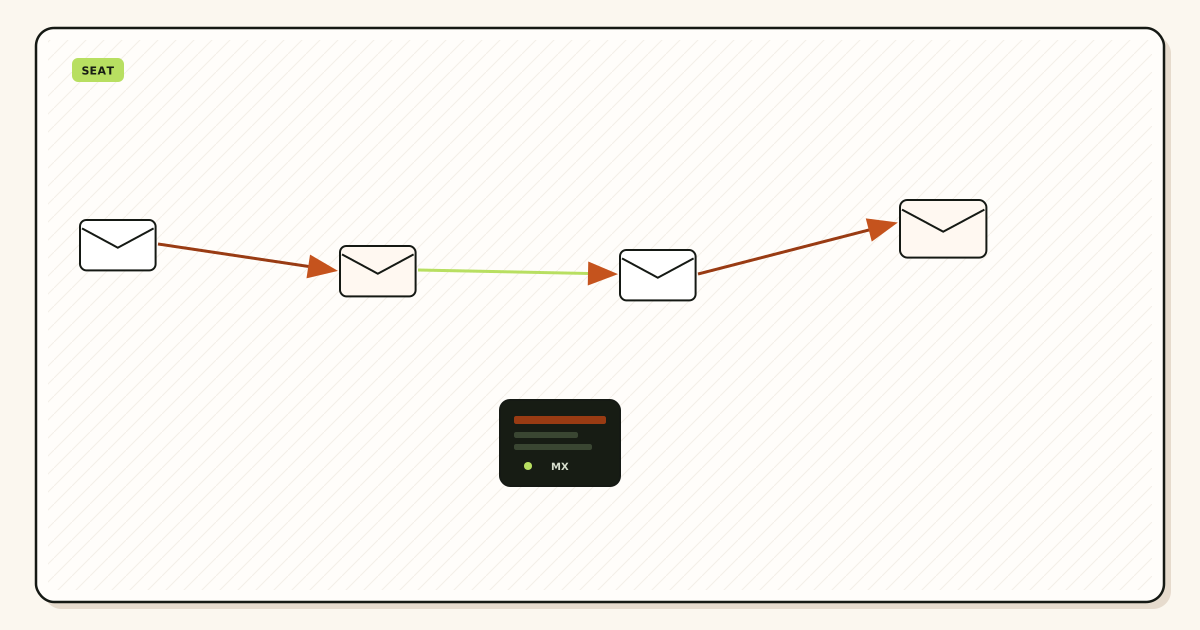
Quick answer for a Google Workspace alternative custom domain email setup
Use Workspace when a person needs a mailbox, Calendar, Drive, and admin you can revoke. Google’s current packaging lives on the Google Workspace — product overview page and changes. Do not treat a blog number as their price list. The unit is a human seat.
Use MailerZ when the domain needs receiving and optional send-as, and the humans already live in Gmail. Aliases are routes, not extra Google licenses. MailerZ accepts MX, preserves Header From, may rewrite only envelope MAIL FROM with SRS, stores a recovery window, and adds authenticated SMTP on paid plans. It is not Workspace. It is not IMAP. It is not an open relay.
The safest Google Workspace alternative custom domain email path is two lists. Column A: people who need a hosted login. Column B: public local-parts that only need to land in an existing inbox. If B is longer, you were about to buy extra seats. A public thread of operators who only wanted forwarding is a snapshot of that waste, not a review: cheap mail hosting, just forwarding.
MailerZ Free is one domain, ten aliases, one seat, a 14-day store, send-as disabled, SMTP and API disabled, and unrouted mail held or rejected only. The MailerZ “seat” is an operator of the delivery account, not a Gmail user. Solo is $40 per year, 25 aliases, 90-day store, 20 send-as per hour, 2,500 outgoing per month. Starter is $8 monthly or $80 yearly with 5 seats on the router and 50 aliases. Business is $19 or $190. Agency is $39 or $390. Unlimited is $99/month or $990/year. Confirm numbers on MailerZ pricing. Product comparison: MailerZ versus Google Workspace. Role routing: aliases and catch-all.
Leftover Google MX beside MailerZ MX is not a hybrid discount. It is a hard stop. Split records lose mail and then someone buys another seat to “fix email.”
The user problem and the decision criteria
Extra seats appear when a founder treats every printed address as a user. support@ gets a Workspace license. press@ gets another. Two humans now fund four mailboxes they will never open. The quote looks like growth. It is a category error.
The opposite error is refusing Workspace when column A is real. A bookkeeper who must retain seven years in a tenant is a seat. A contractor who already lives in Gmail and only needs studio@yourdomain.com forwarded is a route. Write the job next to the name before you open a calculator.
| Question | If yes | If no |
|---|---|---|
| Does this string name a human who needs a mailbox you revoke? | Buy a suite seat. | Create an alias. Do not buy a seat. |
| Does this person need Calendar, Drive, and device admin? | Workspace is the product. | Do not pay per user for MX. |
| Will several people read the same public address? | One alias, one or more destinations—not N seats. | A personal alias into one Gmail is enough. |
| Must replies show the domain? | Paid SMTP send-as. MailerZ Free cannot finish this. See send and reply. | Inbound aliases may be the whole job. |
| Can you publish DNS and delete leftover MX? | Either path can cut over. | Do not start. |
| Is sending personal or operational, not bulk? | MailerZ SMTP is in scope on a paid plan. | Use a campaign platform. |
A no-extra-seat alternative is a poor fit when every contractor must live in a tenant, when counsel wants eDiscovery on every local-part, or when you expect a forwarder to promise Primary-tab placement. It is a good fit when two founders already live in Gmail and eight printed addresses only need routes.
Technical mail flow
Seats and aliases do not share a transport. IETF RFC 5321 — Simple Mail Transfer Protocol is still SMTP. The sender looks up MX. A Google Workspace alternative custom domain email setup changes who answers and whether a new mailbox is created after 250.
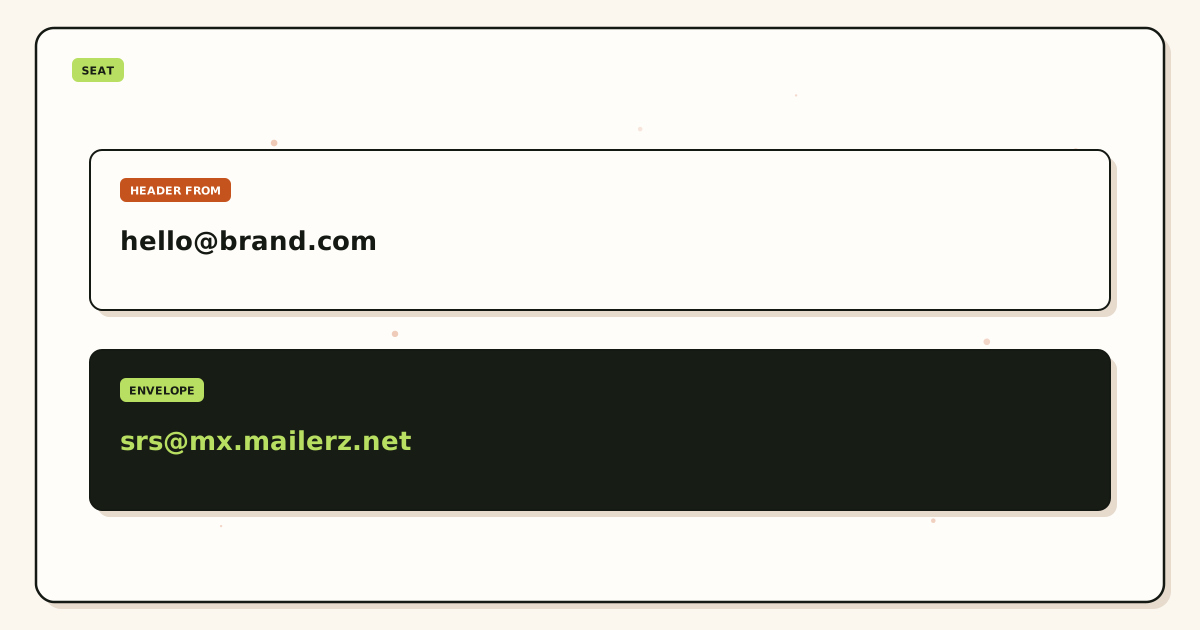
Alias path: no new mailbox
MailerZ MX receives for a verified domain. The edge matches an alias. It stores required content, returns 250, and forwards into the Gmail you verified. Header From stays the original sender. Envelope SRS may rewrite the return path. Delivery history records the destination response. Gmail can still file the copy in spam. That is Gmail’s decision, not a missing Workspace seat.
Unknown recipients on Free are held. That is not a request to buy another Google user. It is a request to name the local-part or enable paid catch-all forward when you mean it. Catch-all is a policy. It is not “unlimited seats.”
Workspace path: a store per seat
Workspace MX points at Google. The message is stored in a mailbox you pay for. Clients log into that mailbox. You bought a store. Use it as a store. Forwarding that mailbox back into consumer Gmail is how teams pay twice and debug twice.
Outbound on the alias path is paid MailerZ SMTP plus Gmail Send mail as. Outbound on Workspace is Google’s submission. Do not run both signers for the same From. SPF, DKIM, and DMARC authorize one sender. IETF RFC 7208 — Sender Policy Framework (SPF), IETF RFC 6376 — DomainKeys Identified Mail (DKIM), and IETF RFC 7489 — Domain-based Message Authentication, Reporting, and Conformance (DMARC) are the texts. They do not make mail inbox.
MailerZ recovery is 14 days on Free, 90 days on Solo through Agency, and 180 days on Unlimited. It is not a Workspace vault. MailerZ seats (1 / 1 / 5 / 25 / 50, then uncapped on Unlimited) let operators rotate SMTP passwords and read history. They do not create Gmail accounts. Translating “5 Starter seats” into “5 Workspace licenses saved” is only honest if you actually avoided five hosted mailboxes.
Step-by-step setup and decision path
This is the Google Workspace alternative custom domain email setup when the goal is no extra seats. Roster first. DNS second. Purchasing third.
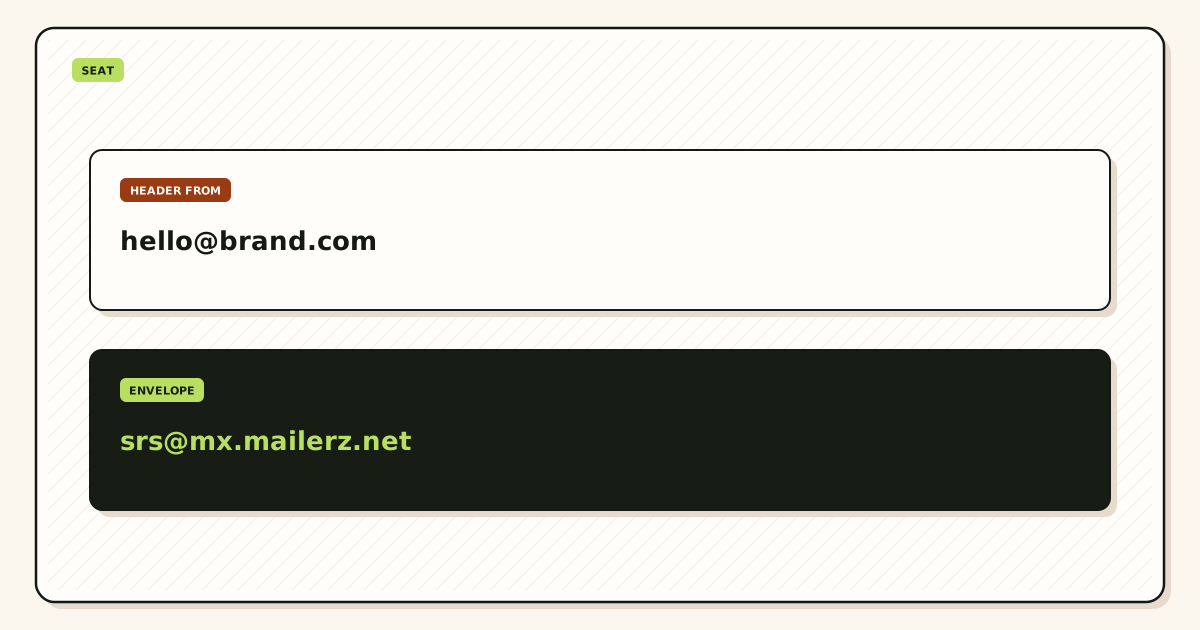
Write people and addresses in two columns
A name with a need for tenant admin belongs in Workspace. A role string that several people read belongs in MailerZ as one alias. If you cannot decide, the default is alias, not seat, until someone asks for Calendar.
Price only column A on Google’s current page
Multiply Workspace by humans, not by local-parts. If that number exists only to host
billing@, you found the extra seat. Stop buying it.Add one domain on MailerZ and verify TXT
Use the root domain. Publish the unique verification TXT. Receiving stays off until the check passes. Do this before you delete Google records if a trial MX is already live.
Create aliases for every printed role
Map destinations to the Gmail inboxes that already exist. Complete destination verification. Free allows ten aliases. Count column B against Solo 25, Starter 50, Business 200, Agency 500, then uncapped on Unlimited. Do not invent a Workspace user to dodge the alias ceiling.
Publish one MX set and delete leftovers
Copy MailerZ hosts. Remove leftover Google MX. If a person in column A truly needs Workspace, give them a Workspace login and keep domain MX on one stack. Dual MX is not “some seats, some aliases.” It is lost mail.
Prove inbound from a different mailbox
Unique subject. Unrelated provider. Confirm Header From. Open history. Self-send from the same Gmail account can hide leftover MX and a missing alias at once.
Add paid send-as only if the role must reply as itself
Free has no send-as. Solo and above add SMTP. Configure Gmail Send mail as. Test to a second external inbox. A role that only receives can stay inbound-only. That is how you avoid both extra seats and unused SMTP.
Failure modes and proof
Most “we still need more seats” reports are leftover MX, an unnamed alias, or a team that expected IMAP on MailerZ. Work the evidence before you open Google billing.
| What you see | Likely cause | Proof to collect |
|---|---|---|
| Role address never arrives | Alias missing. Free holds unknown recipients. | Alias list versus envelope recipient. Create the local-part; do not buy a seat. |
| Some senders reach Workspace | Leftover Google MX. | Public MX from two resolvers. One set only. |
| Replies leave as @gmail.com | No paid SMTP, or default Gmail identity. | From selector. Plan send-as limits. Not a missing Workspace user. |
| “We have no admin for that mailbox” | You bought a route and expected a suite. | If the human needs tenant admin, they are column A. Buy that seat only. |
| Self-send never appears | Gmail short-circuited a message to itself. | Repeat from a different provider. |
| SMTP 550 on send | Unhosted domain, unauthorized From, or open-relay refusal. | Exact SMTP response. MailerZ is not an open relay. |
| Board asked for SOC 2 | Wrong shopping list. | MailerZ is not SOC 2. Controls: Security. |
Proof is a sanitized header block plus the receiving event with timestamp and remote response. Inbox placement is not proof you saved a seat. DNS diagnostics: troubleshooting.
MailerZ workflow and product boundary
MailerZ is a custom-domain email delivery layer operated by Secuno LLC. Point MX at MailerZ. Mail for a hosted, verified domain can land in Gmail or Outlook. Paid plans add authenticated SMTP. Site: mailerz.net. App: mail.mailerz.net.
Positioning: avoid buying full mailbox seats for addresses that only need routing. If the address needs a mailbox, buy a mailbox.
What MailerZ does
- Accept inbound mail for verified domains and configured aliases.
- Preserve Header From on the forward into Gmail or Outlook.
- Hold or forward unknown recipients according to plan and settings.
- Store messages 14 days on Free, 90 days on Solo through Agency, or 180 days on Unlimited.
- Send through authenticated SMTP from approved identities on paid plans.
- Record delivery history. Treat leftover MX as a hard stop.
- Give operators seats that are not Gmail mailboxes.
What MailerZ does not do
- Replace Workspace with IMAP, Calendar, Drive, or device management.
- Rewrite header From, Subject, Date, Message-ID, body, or MIME.
- Offer send-as on Free.
- Promise inbox placement, uptime SLAs, or review counts.
- Claim SOC 2, ISO 27001, or HIPAA.
- Act as an open relay or a campaign sender.
- Quote Google’s price. That number lives on Google’s site.
Plan shape when you refuse extra suite seats: Free to prove ten aliases; Solo for one operator and 25 roles; Starter when five people share the router. Annual Starter, Business, and Agency include two months free versus monthly. Solo has no monthly option.
Cost, alternatives, and trade-offs
The unit error is the whole article. Workspace × printed addresses is how extra seats appear. MailerZ × aliases is how routes are priced. Put Google’s current per-user price next to column A yourself. Put MailerZ cards next to column B.
| Approach | You get | You give up |
|---|---|---|
| Workspace for every address | A mailbox login per string. | Money and empty seats. |
| Workspace for people, MailerZ for roles | Only if MX is exclusive. Usually you should pick one receiving answer. | Operational clarity if you try dual MX. |
| MailerZ aliases into existing Gmail | Routes, history, paid SMTP, no extra suite seats. | No hosted mailbox, published send limits, you operate DNS. |
| Inbound-only forwarder | Receiving without send-as. | Replies leave as @gmail.com unless you add SMTP. |
Example that stays honest because it uses MailerZ numbers only: two founders in Gmail plus hello@, billing@, jobs@ fit Free for inbound. Adding send-as is Solo at $40 per year. Eight more role aliases still fit Solo. A fifth human who needs Drive is a Workspace seat, not Agency. Cloudflare Email Routing can create durable forwards; it is not stored hops or paid send-as. Read Cloudflare — Email Routing documentation if that is your DNS. ImprovMX is the closest forwarding class: ImprovMX — product documentation.
Contractors: designer with Gmail is a route. Bookkeeper with a retention duty is a seat. Support volume that exhausts Solo’s 20 send-as per hour is a plan bump or a help desk, not a reason to buy five empty Workspace mailboxes.
Shared inboxes tempt people back into extra seats. Three founders want to read hello@. That is one alias with one destination they already share, or three destinations if MailerZ allows the plan to fan out—not three Workspace users named Hello. If the product cannot attach multiple destinations, pick one shared Gmail and give people access there. The cost of a shared consumer inbox is still lower than three hosted seats you will ignore.
Seasonal addresses are the other trap. jobs@ for a hiring month does not need a mailbox that renews all year. Create the alias, prove inbound, pause or delete it when the role ends. A Workspace seat sold as “just for hiring” tends to survive in billing long after the listing comes down. Aliases are easier to retire because nobody built a login habit around them.
Agencies: count client domains before you count seats. Free is one domain. Solo is five domains. Starter is eight. Business is 25. Agency is 100. Recreating a client’s role list on Free will fail alias math. You are still not buying Workspace seats for info@client.com unless that client needs a tenant. You are picking a MailerZ card that fits domain and alias ceilings.
A ten-person company that prints twelve role addresses is the usual spreadsheet. Two founders already live in Gmail. Eight contractors have their own inboxes. The twelve roles are hello, support, billing, jobs, press, legal, security, partners, sales, invoices, careers, and abuse. Workspace × twelve is twelve hosted mailboxes you will not open. MailerZ Solo covers twenty-five aliases and five domains at $40 per year if send-as is required. Free covers the first ten aliases inbound-only. The two founders stay on Gmail. Nobody in that model needs a Workspace seat unless they also need Calendar, Drive, or a tenant you can revoke. If one hire later needs those suite tools, buy that one seat and keep domain MX on one stack. Dual MX is not “some seats, some aliases.”
The same math fails if counsel wants a tenant archive, if every contractor must use a managed mailbox, or if you want the vendor to promise inbox placement. Those are suite or ESP jobs. MailerZ will not become Workspace because you renamed the SKU. Write the two columns again before you upgrade a card.
FAQ
What is the safest way to handle a Google Workspace alternative for custom domain email without extra seats?
Split people from addresses. Buy Workspace only for humans who need a hosted mailbox, Calendar, and admin. Route role addresses as aliases into Gmail or Outlook you already use. Publish one MX set, delete leftover Google MX, and prove inbound from a different mailbox. Do not buy a seat for billing@.
Does this require a new mailbox?
Not for aliases. MailerZ is Mail Box portal webmail (Inbox, Sent, New email). It is not IMAP or POP. The destination stays Gmail or Outlook. Workspace requires a new mailbox when the suite is the store. Mixing leftover Google MX with a forwarder loses mail.
Will it work with Gmail or Outlook?
Yes for inbound aliases into verified Gmail or Outlook destinations. Paid MailerZ send-as uses Gmail Send mail as or a manual Outlook SMTP identity. Free has no send-as. Workspace clients are a different login if you chose the suite for those people.
What DNS records are involved?
A verification TXT, one MailerZ MX set, leftover Google or host MX removed, and SPF, DKIM, and DMARC if you send as the domain. Workspace uses Google’s MX instead. One receiving answer only.
What should I test before production?
Send a uniquely titled message from an unrelated provider into each role alias. Confirm Header From and delivery history. Then send outward through the identity you will print. Self-send from Gmail to the same Gmail account can hide routing errors.
Key takeaways
- A Google Workspace alternative for custom domain email without extra seats means aliases for roles, seats only for people.
- MailerZ seats operate the router. They are not Gmail or Workspace licenses.
- Do not buy a suite user to host billing@.
- Header From stays the original sender. Envelope SRS is the allowed rewrite.
- Leftover Google MX is a hard stop. Dual MX is not a hybrid plan.
- Test inbound from a different mailbox. Self-send lies.
- Free has ten aliases and no send-as. Solo is $40 per year when From must travel.
- Price Workspace from Google’s page. Price routes from /pricing.
- MailerZ is not SOC 2, not IMAP, and not a bulk sender.
Conclusion and next action
Extra seats are what you buy when you confuse a printed string with a person. Keep Gmail for the humans who already have it. Route the rest. Publish one MX set. Prove inbound. Add paid SMTP only if the role must reply as itself. Buy Workspace for the people who need the suite, not for the addresses that needed a route.
MailerZ fits that split with delivery history and a recovery window. It does not fit when every user needs a hosted mailbox or campaign-scale sending. Start on Free if you only need to watch inbound. Move to Solo or Starter when alias count or send-as requires it. If a later hire needs Calendar, buy that one Workspace seat and keep domain MX on one stack.
Next action: write the two columns, add one domain, create the first role alias, and send a uniquely titled message from a mailbox that is not the destination. Search All Mail if history already shows 250.
Ready to stop buying seats for addresses
Start free with one domain and prove the path.
Ten aliases on Free. Paid send-as when the From identity has to travel. Sign in if the domain is already there.
Review quarterly, or sooner if Workspace packaging, MailerZ alias limits, or DNS guidance changes. Author: MailerZ editorial, Secuno LLC.