Catch all email spam risk is what you buy when convenience means “accept every leftover local-part.” A printed alias is a name you chose. Catch-all FORWARD is a hose: typos, harvested first names, and directory guesses reach the inbox you already read. Holding unknowns is the safer default. Forward leftovers only when you can watch them. MailerZ Free holds. Paid catch-all FORWARD is optional, not a completeness badge.
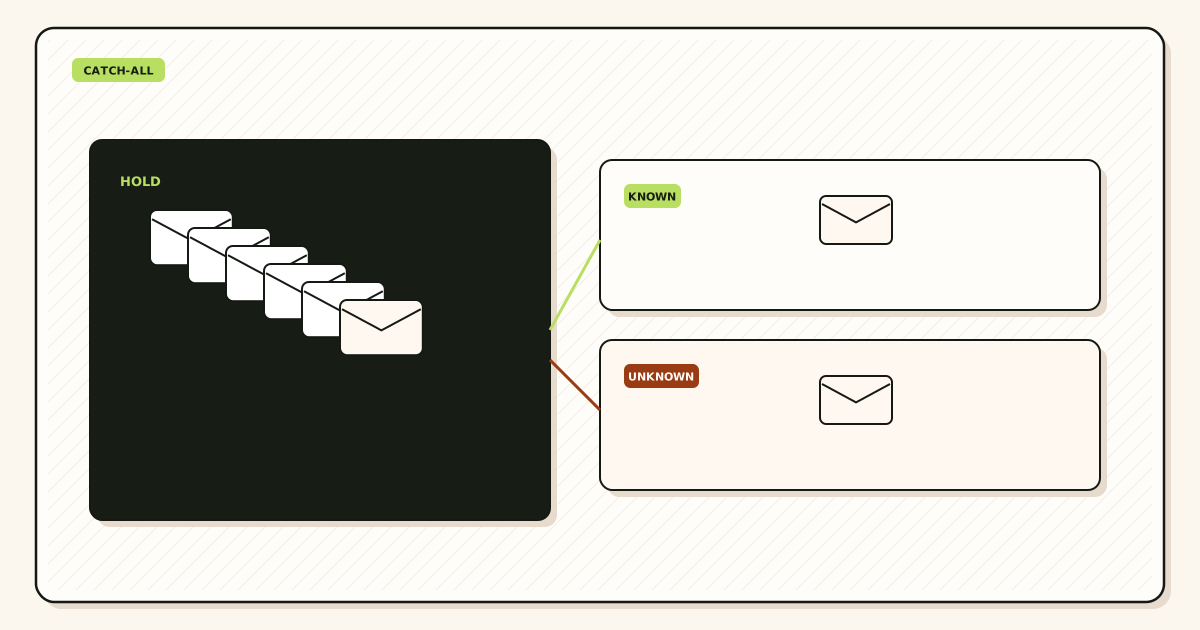
Quick answer for catch all email spam risk
Treat catch-all as two jobs, not one feature. The first job is “do not lose a typo during a cutover.” The second is “do not train the internet that every string on this domain is a live mailbox.” Those jobs fight. If you enable catch-all FORWARD on day one so you never have to create aliases, you chose the second job and called it convenience. That is the core of catch all email spam risk.
On MailerZ, unknown recipients are held on Free. Paid plans can forward unknowns when you enable that behavior. Holding is the default that lets you read leftovers without dumping them into Gmail. Forwarding is a watched window: a migration week, a printed typo you have not created yet, a partner who still uses an old string. It is not a forever setting to hide missing names. Product language lives on aliases and catch-all.
Transport still follows IETF RFC 5321 — Simple Mail Transfer Protocol. The sender looks up MX, offers an envelope recipient, and transfers content. Your system then accepts, holds, or rejects that local-part. Accepting every leftover string tells scanners the domain is live for any guess. Holding still accepts at the edge for recovery, but it keeps the destination inbox out of the blast. Rejecting unknown recipients can reduce dictionary noise and can also bounce real typos. Pick the policy you can explain.
Envelope Sender Rewriting Scheme may rewrite the return path so destination SPF can survive the hop. Header From, Subject, Date, Message-ID, body, and MIME stay as received. Catch-all does not rewrite identity. It only decides whether an unmatched local-part is a route. Spam filters at Gmail or Outlook still judge volume, reputation, and content. More leftover traffic means more chances those filters guess wrong.
Google’s people-first guidance is about pages, not SMTP; see creating helpful, reliable, people-first content. Do not treat a ranking essay as a spam guarantee. Alias privacy write-ups on sites such as addy.io’s blog discuss hiding personal inboxes. That is a different product class. A custom-domain catch-all is not a disposable identity. It is a policy on a domain you print on invoices.
The user problem and the decision criteria
People turn on catch-all because they are tired of creating names. A contractor used jobs@ last year. A PDF still lists info@. A form auto-completed founder@. Convenience feels like never missing mail. The spam risk is that the same open door accepts dictionary first names, role guesses, and harvested directories. Those messages are not “maybe useful.” They are load on the inbox you already trust.
| Question | If yes | If no |
|---|---|---|
| Can you name every public address this week? | Create those aliases. Leave unknowns held. | Hold leftovers. Do not FORWARD to hide the gap. |
| Is this a watched cutover window? | Paid FORWARD can be temporary. Review daily. | HOLD is the everyday policy. |
| Will Gmail be the only store you read? | FORWARD dumps noise into that store. | You are shopping for hosting, not catch-all. |
| Can leftover MX be deleted? | Policy can apply to the whole domain. | Stop. Split MX loses mail before catch-all matters. |
| Do invented strings need to send? | That is not catch-all. Named send-as is paid and explicit. | Inbound policy only. Free cannot send-as anyway. |
Harvested directories are the quiet version of catch all email spam risk. A leaked staff page, a Git commit, or a conference badge list becomes a word list. Senders try first.last@, first@, and role@ in bulk. If your policy forwards every hit, the destination treats that volume as ordinary inbound. Filters then become stricter for the named aliases you actually print. Convenience for typos becomes a reputation tax on hello@.
Typos are the honest case for catch-all. A customer types suport@ instead of support@. HOLD lets you see that miss and create the name, or recover the body from the store. FORWARD delivers the typo and also delivers every other misspelling scanners invent. If you only wanted the one typo, create suport@ as a named alias for a month, then delete it. That is cheaper in attention than leaving the hose open.
Role guesses are the third stream. sales@, billing@, admin@, office@, and hr@ get tried whether you printed them or not. If those names are real jobs, create them and map destinations. If they are not, HOLD shows you the attempts without staffing a fake department. Enabling FORWARD “just in case” staffs every guess with your personal inbox.
Plus addressing is not a catch-all substitute and not a spam control. you+vendor@gmail.com is a filter tag on one mailbox. Forms reject plus signs. A named billing@ on your domain is ordinary SMTP. Catch-all FORWARD of random+tags on your domain is still leftover traffic. Do not confuse a Gmail plus tag with a domain policy.
Disposable inboxes and privacy aliases hide a personal address from shops. They expire or rotate. Catch-all on a company domain does the opposite: it keeps every guess alive. If you need throwaway identities, use a product built for that. Do not open catch-all FORWARD on the domain that receives invoices because a privacy blog praised “catch everything.”
Technical mail flow
A sending server looks up MX, connects, offers MAIL FROM, names recipients, and transfers content. MailerZ accepts for a verified domain. If the local-part matches a named alias, the message is stored as required and forwarded to the destination you verified. If the local-part matches nothing, Free holds it. Paid plans hold it unless you enabled catch-all FORWARD. Envelope SRS may rewrite the return path. Header From stays the author.
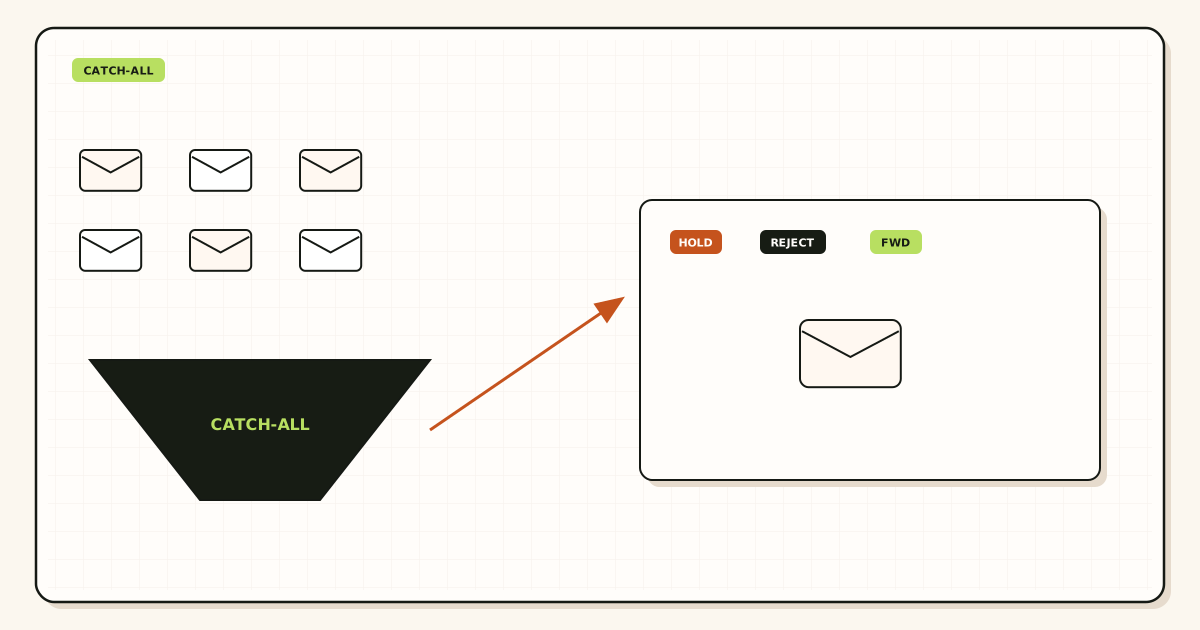
Acceptance versus bounce is the SMTP-visible half of catch all email spam risk. If the server always returns 250 for any local-part, directory scanners learn the domain is a live sink. If the server rejects unknowns, some real typos bounce and some scanners move on. MailerZ HOLD is not a silent discard at the edge. It is a store you can open. That is why HOLD is useful during setup: you see what the internet tried without training Gmail on the whole set.
Destination filters do not see HOLD the same way they see FORWARD. A held message sits in MailerZ recovery for the plan window: 14 days on Free, 90 days on paid. It is hop evidence, not a second archive and not legal hold. Gmail or Outlook remains the system of record you search next year. FORWARD puts the leftover body into that system of record. Once it is there, your spam folder, filters, and search history own it.
SPF, DKIM, and DMARC evaluate authorization of the hop, not whether you should have accepted the recipient. IETF RFC 7208 — Sender Policy Framework (SPF), IETF RFC 6376 — DomainKeys Identified Mail (DKIM), and IETF RFC 7489 — Domain-based Message Authentication, Reporting, and Conformance (DMARC) are the documents. A catch-all FORWARD that preserves Header From still arrives as the original author. That is good for threads. It is also how a forged campaign using a lookalike local-part still looks “from” someone the destination already knows. Volume plus familiar From is how filters get jumpy. HOLD lets you decide before that volume lands.
Leftover MX is a hard stop. Old Google, Microsoft, or registrar records beside MailerZ MX split inbound. Some senders reach the old host. Some reach MailerZ. Catch-all policy on MailerZ cannot recover the half that never arrived. Read the public set from two resolvers before you debate HOLD versus FORWARD. Delivery history for the half that did arrive lives on delivery and recovery.
Self-send from Gmail to the same Gmail account can short-circuit. The client may show a copy without proving MX, alias, or catch-all. Budget an external mailbox for both the named-alias probe and the made-up-local-part probe. The second probe is how you confirm HOLD versus FORWARD without guessing.
Outbound SMTP is a different path. Paid plans authenticate a session, check the From identity, apply hourly and monthly caps, and submit. Catch-all does not mint send-as identities for leftover strings. Free has no send-as. Unauthorized or unhosted recipients get 550 / 550 5.7.1. MailerZ is not an open relay. Do not enable FORWARD because you thought every leftover address could also send.
Campaign mail is out of scope. Dictionary blasts that hit your catch-all are inbound abuse, not a reason to raise outgoing caps. Solo’s 2,500 outgoing and 20 send-as per hour, Starter 5,000 and 40, Business 12,000 and 60, Agency 20,000 and 60 are stop signs for your own sending. They do not absorb inbound junk.
Multi-destination aliases are still named routes. Mapping support@ to two people is not catch-all. Catch-all is the unmatched set. If you want two people on leftovers, you are asking FORWARD to fan-out noise. Prefer one watched destination for a temporary FORWARD window, then turn it off.
Operator seats on Starter and above are dashboard logins. They are not hosted mailboxes and not extra catch-all sinks. Agency’s 50 seats and 100 domains are for people who run many zones. Each zone still needs its own alias list and its own HOLD versus FORWARD decision. Copying “FORWARD everywhere” across client domains is how agencies inherit catch all email spam risk at scale.
Step-by-step setup and decision path
Write the printed names before you touch catch-all
List every local-part that appears on a site, invoice, or signature. Those are aliases, not leftovers. Free allows three. Solo allows twenty-five. If the list is longer than the plan, upgrade for aliases, not for FORWARD. Creating the names is the spam control.
Add one domain and map those aliases
Verify TXT. Map each name to a destination you already read. Do not loop a destination back through the same domain. Confirm the destination accepts mail from MailerZ before you cut MX.
Publish one MX set and delete leftovers
Copy the dashboard MX. Read the public set from two resolvers. Remove obsolete Google, Microsoft, and registrar records. Catch-all policy cannot unify two inbound owners.
Prove each named alias from another mailbox
Unique subject, Header From intact, delivery history present. If history is empty, MX or the alias is wrong. If history says 250 and Gmail is empty, the destination filtered. Neither is an inbox SLA breach.
Probe a made-up local-part and read HOLD
Send to a string you will never print. Confirm it is held on Free, or held on paid unless you enabled FORWARD. Open the body in recovery if you need it. Create a named alias only if the leftover is a real job.
Enable paid FORWARD only as a watched window
Write the end date. Review held or forwarded leftovers daily. Turn FORWARD off when the printed names exist. Do not leave it on because convenience felt cheaper than naming.
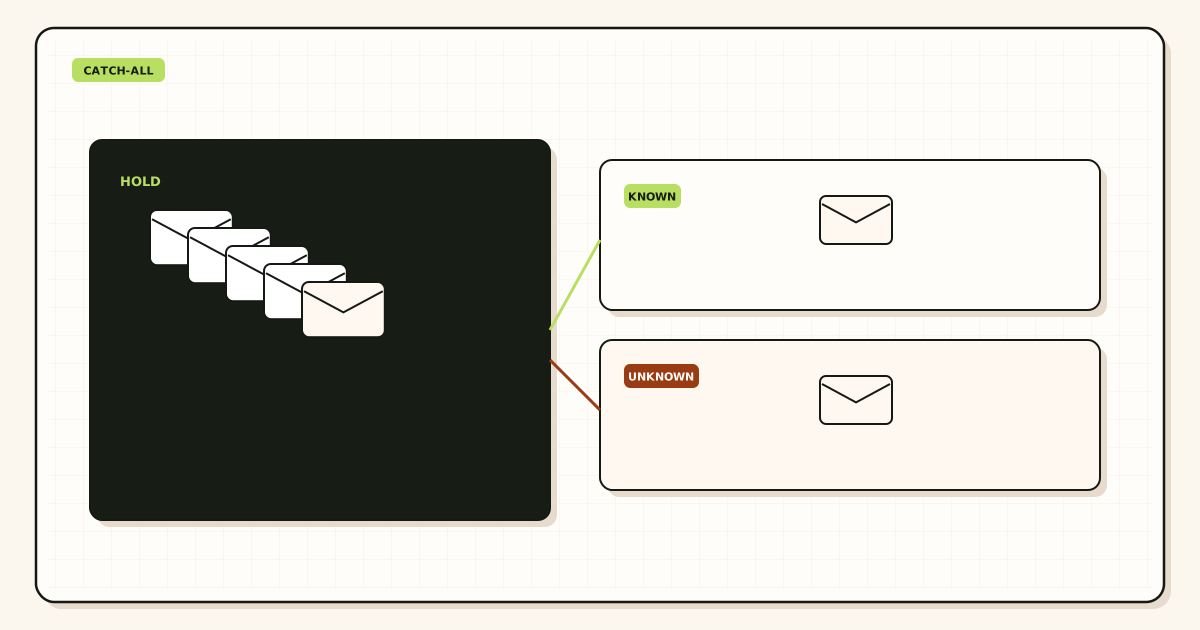
Failure modes and proof
| What you see | Likely cause | Proof |
|---|---|---|
| Gmail fills with first.last guesses | Catch-all FORWARD on a harvested domain. | Turn FORWARD off. Create only printed names. Review HOLD. |
| Named aliases start hitting spam | Leftover volume trained destination filters. | Reduce FORWARD. Prove hello@ from another mailbox. |
| A real typo never arrived | HOLD unread, or leftover MX ate the hop. | Open recovery. Read public MX from two resolvers. |
| Some senders hit the old host | Leftover MX. | Delete obsolete records. Policy cannot split-heal. |
| Self-send never appears | Client short-circuit. | Repeat named and unknown probes from another provider. |
| History delivered, empty inbox | Destination filter on a forwarded leftover or alias. | Spam, promotions, remote 250. No inbox SLA. |
| Someone replies as a leftover string | They invented send-as. Catch-all does not grant it. | Paid named identity only. Free has no send-as. |
| Recovery gone after two weeks | Free store ended. | Paid 90-day store. Gmail is still the archive for FORWARD. |
Proof is a header block plus a MailerZ event. Do not send SMTP passwords. Do not publish verification tokens. A catch all email spam risk argument that cannot show HOLD versus FORWARD for one made-up local-part is still a guess.
If FORWARD was on for months, turning it off will not empty Gmail. It only stops new leftovers. Create the names you still want. Leave the rest held. Expect destination filters to calm down over time; do not promise a date. There is no inbox-placement SLA on any plan.
Shared inboxes and Google Groups look like catch-all and are still suite objects. They follow suite MX. A MailerZ leftover policy follows MailerZ MX. Dual MX is not a hybrid that “covers” both. It is split delivery. Pick one inbound owner, then decide HOLD versus FORWARD on that owner only.
Auto-complete on phones invents local-parts from old threads. Those strings are leftovers unless you created them. HOLD shows the miss. FORWARD delivers it and trains the destination that the miss is a real route. If a partner keeps using an old string, create that one alias. Do not keep the hose open for one partner.
MailerZ workflow and product boundary
MailerZ is a custom-domain delivery layer operated by Secuno LLC. Point MX at MailerZ. Mail for a verified domain lands in Gmail or Outlook, or sits in HOLD when the local-part is unknown on Free. Paid plans add optional catch-all FORWARD and authenticated SMTP. Site: mailerz.net. App: mail.mailerz.net.
- Free $0: 1 domain, 10 aliases, 14-day store, send-as disabled, SMTP and API disabled.
- Solo $40/yr: 5 domains, 25 aliases, 90-day, 2,500 outgoing, 20 send-as/hr, unknown can FORWARD when enabled.
- Starter $8/$80: 8 domains / 50 aliases / 5 seats, 5,000 outgoing, 40/hr.
- Business $19/$190: 25 / 200 / 25, 12,000 outgoing, 60/hr.
- Agency $39/$390: 100 / 500 / 50, 20,000 outgoing, 60/hr.
MailerZ is not IMAP, not a suite, not an open relay, not an inbox SLA, not SOC 2 / ISO 27001 / HIPAA. Controls: Security and Trust Center. Unauthorized send returns 550 / 550 5.7.1. Annual Starter, Business, and Agency include two months free versus monthly. Solo has no monthly option. Dashboard seats are operators, not Gmail logins. Confirm MailerZ pricing the day you buy. Limits are not an inbox promise.
Setup copy and recipient policy live on aliases and catch-all. Hop evidence lives on delivery and recovery. Do not enable FORWARD because the dashboard can. Enable it because you wrote a window and a reviewer.
Cost, alternatives, and trade-offs
The cheap-looking choice is catch-all FORWARD so you never create aliases. The expensive choice is Gmail trained on harvested names, plus time spent fishing a real invoice out of spam. Alias capacity is the honest line item. Free includes three names. Solo includes fifteen at $40 per year. If you printed twelve roles, pay for aliases. Do not pay for FORWARD to avoid naming twelve roles.
| Approach | You get | You give up |
|---|---|---|
| Named aliases + HOLD | Printed routes. Leftovers visible without inbox dump. | You must create the names you print. |
| Paid FORWARD window | Typos during cutover reach Gmail. | Harvested names can ride along. Needs a stop date. |
| Forever FORWARD | Maximum convenience. | Maximum catch all email spam risk. |
| Hosted suite catch-all | A stored mailbox as the sink. Quote the vendor live. | Per-user cost if Gmail already held the mail. |
| Reject unknowns at SMTP | Less dictionary sink behavior. | Real typos bounce. MailerZ HOLD is the recovery-friendly middle. |
Privacy-alias products and plus-addressing guides solve a different job: hide a personal inbox from vendors. Research those write-ups if that is the job. They are not a reason to open catch-all FORWARD on a company domain. ImprovMX and other inbound routers have their own leftover policies. Read their live docs. Do not copy last year’s screenshot into a production MX change.
Time is a line item. Ten minutes naming aliases costs less than a week of leftover mail. Leftover MX costs more than Solo. A Free-plan branded-reply promise costs more than the upgrade. Budget one external unknown-recipient probe as part of cutover, not as optional polish.
If every teammate needs a hosted mailbox, a suite catch-all lands in that store with suite admin. A forwarder will look incomplete because it is incomplete for stored humans. If two people need seats and twelve printed names are routes, price two seats plus MailerZ aliases, not fourteen seats plus forever FORWARD.
Registrar cost sits next to the forwarder. A .com renewal is often tens of dollars. Quote your registrar. That line does not change when you switch HOLD to FORWARD. The incremental cost of FORWARD is attention and destination filter load, not a MailerZ sticker.
Monthly versus yearly is cash flow. Starter, Business, and Agency yearly cards include two months free versus twelve monthly payments. Solo is $40 per year only. Do not prepay Agency to “afford” catch-all. Alias count and domain count are the cards that scale. Catch-all is a policy bit.
Open a held body for break-glass recovery and expect an audit row. That is a control, not a SOC 2 badge. Do not send SMTP passwords or verification tokens to support. The artifacts that close a catch all email spam risk argument are the alias list, the HOLD versus FORWARD setting, public MX, and one made-up-local-part probe with a timestamp.
FAQ
What is the safest way to handle catch all email spam risk?
Name every public local-part, publish one MX set, and leave unknown recipients held. Catch-all FORWARD is a watched window on paid plans, not a substitute for aliases. Review held mail, create the missing name, and only then decide whether leftovers should reach Gmail. Do not enable FORWARD to hide incomplete routing.
Does this require a new mailbox?
No. Catch-all is a recipient policy after MX already points at MailerZ. Named aliases and held leftovers still land in, or sit beside, the Gmail or Outlook inbox you already use. MailerZ is Mail Box portal webmail (Inbox, Sent, New email). It is not IMAP or POP. Buy a hosted mailbox only if you need a stored seat, Calendar, or lockable store.
Will it work with Gmail or Outlook?
Yes for destinations you verify. Named aliases forward into those inboxes. Unknown local-parts stay held on Free. Paid plans can forward unknowns when you enable that policy. Destination spam folders still belong to Gmail or Outlook. Catch-all FORWARD increases volume those filters must judge. It does not create send-as for invented strings.
What DNS records are involved?
A verification TXT, one MailerZ MX set, leftover host MX removed, and SPF, DKIM, and DMARC if you also send as a named address. Catch-all is not a DNS record. It is a policy after the envelope recipient is offered. Leftover MX splits mail before any hold or forward rule can help.
What should I test before production?
Probe each printed alias from an unrelated mailbox. Confirm Header From and delivery history. Then send to a made-up local-part. On Free it should be held. On paid it should stay held unless you enabled FORWARD on purpose. Self-send from Gmail to the same Gmail account can hide both alias and catch-all outcomes.
Key takeaways
- Catch all email spam risk is leftover FORWARD, not the existence of a hold queue.
- Print aliases first. Free allows 3. Solo allows 15 at $40/yr.
- MailerZ Free HOLDs unknowns. Paid FORWARD is optional and should have a stop date.
- Do not enable FORWARD to hide missing names.
- Leftover MX splits mail before any catch-all policy matters.
- Envelope SRS only. Header From untouched. Not an inbox SLA.
- Catch-all does not create send-as. Free has no send-as.
- Probe named aliases and one made-up local-part from another mailbox.
Conclusion and next action
Convenience and catch all email spam risk are the same policy seen from two sides. If you name the addresses you print and hold the rest, you keep Gmail readable. If you forward every leftover string so you never create aliases, you staff harvested directories with your inbox. MailerZ Free is built for the first path. Paid FORWARD exists for a watched window. It is not a forever default.
Ready to name the aliases
Start free with one domain and watch HOLD.
Inbound on Free. Solo when send-as or a temporary FORWARD window is the job. Sign in if the domain is already there.
Review quarterly, or sooner if MailerZ leftover policy or provider DNS guidance changes. Author: MailerZ editorial, Secuno LLC.